

Context
Judu is Vilnius's unified transit platform — public transport, parking, micro-mobility, one app. I picked the micro-mobility brief during my final year and worked with Judu's product team throughout.
The module was backed by a 60–70 page thesis covering UX/UI research and competitor analysis.
Role
Sole designer on the micro-mobility module. The other modules were designed internally by Judu's team.
Outcome
I presented it in full after my thesis defense. Parking and public transport later shipped as an MVP through an outside agency, after Judu restructured internally. Micro-mobility wasn't part of that release — whether it still joins is theirs to decide.


Micro-mobility had no product yet, unlike the other two modes. Riders didn't see themselves in Judu — that's a positioning problem, not a design one.
Solution: one color ties it together — orange, pulled from Vilnius's cycling lane markings, used everywhere the micro-mobility part shows up.


Potholes and hazards go unreported until someone gets hurt.
Solution: riders photograph and flag them — a heads-up to other riders, a signal to the city on where to fix roads. Same pattern as Waze, applied to cycling infrastructure that rarely gets it.

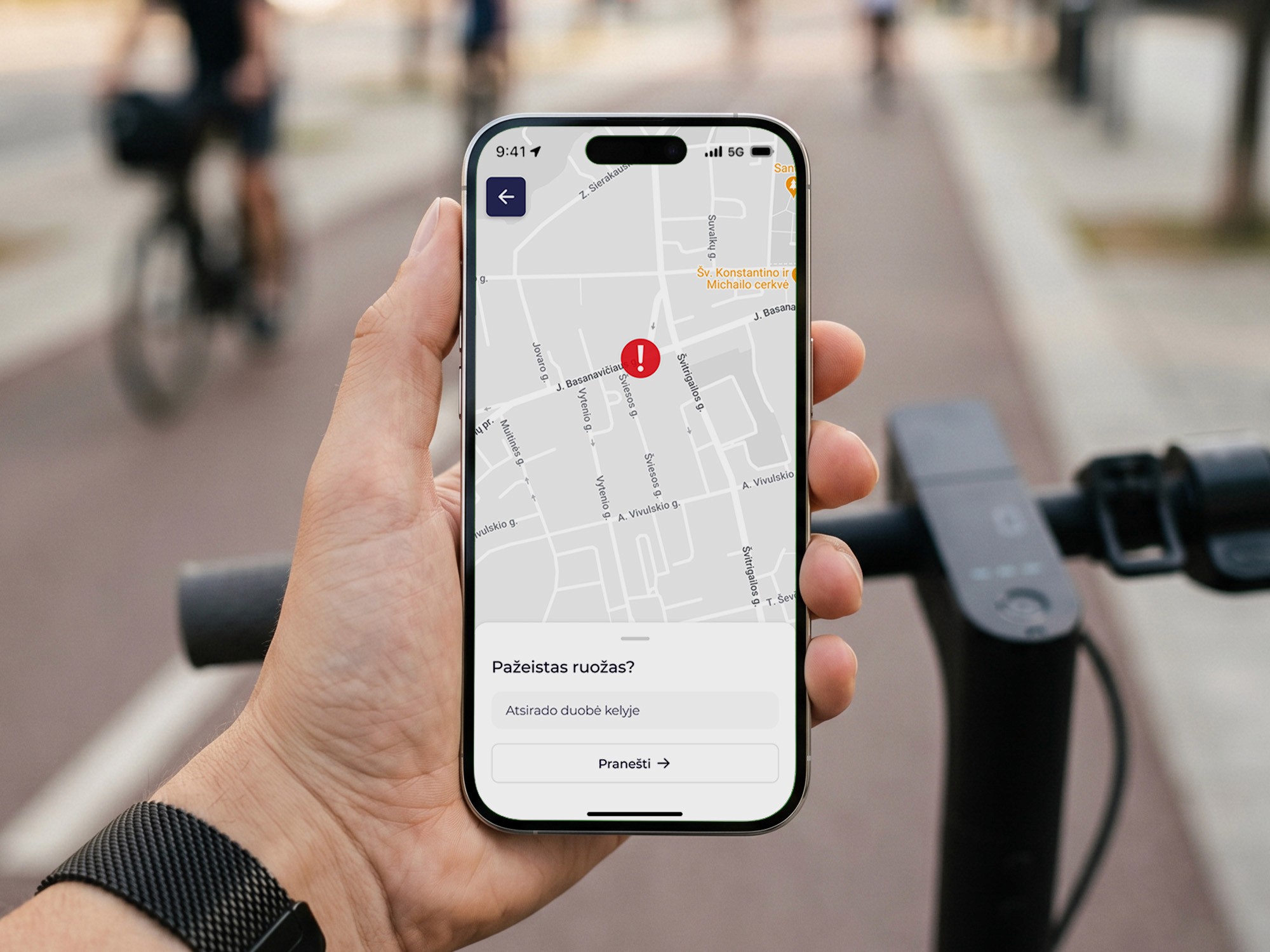


Most transit maps bury the road under cafés, museums, and points of interest — clutter for someone riding at 9pm.
Solution: strip it to roads, routes, riding-relevant points. Night mode dims the rest so the eye stays on the road.


A stock icon set reads generic from the first screen.
Solution: drew the icons from scratch. Linear weight, lightly rounded, matched to the app's geometry — same style as Judu's logotype.


Built in Figma with local variables and components — color, type, spacing, radii, shadows — wired so changes propagate.
The module ran as a working prototype, not static screens. At my thesis defense, a committee and outside visitors used it live while I walked through the core flows.
Two months. Thesis work gives you room a shipped product doesn't. I still had to make it hold up as one. That meant cutting ideas that were interesting but didn't belong.

Next project

B2C gift-giving app